Bonn from Cologne: Beethoven’s Birth House, a Capital That Handed It Back, and the Cherry Tunnel
Half an hour up the Rhine, Beethoven’s birth house keeps the ear trumpets and manuscripts — in a town that served as capital for fifty years and handed the job back, and tells that story free of charge.
The short version
- Trains run Cologne to Bonn in 20–30 minutes at commuter fares and metro-grade frequency (bahn.de), with the old town and Beethoven-Haus ten minutes’ walk from the Hauptbahnhof.
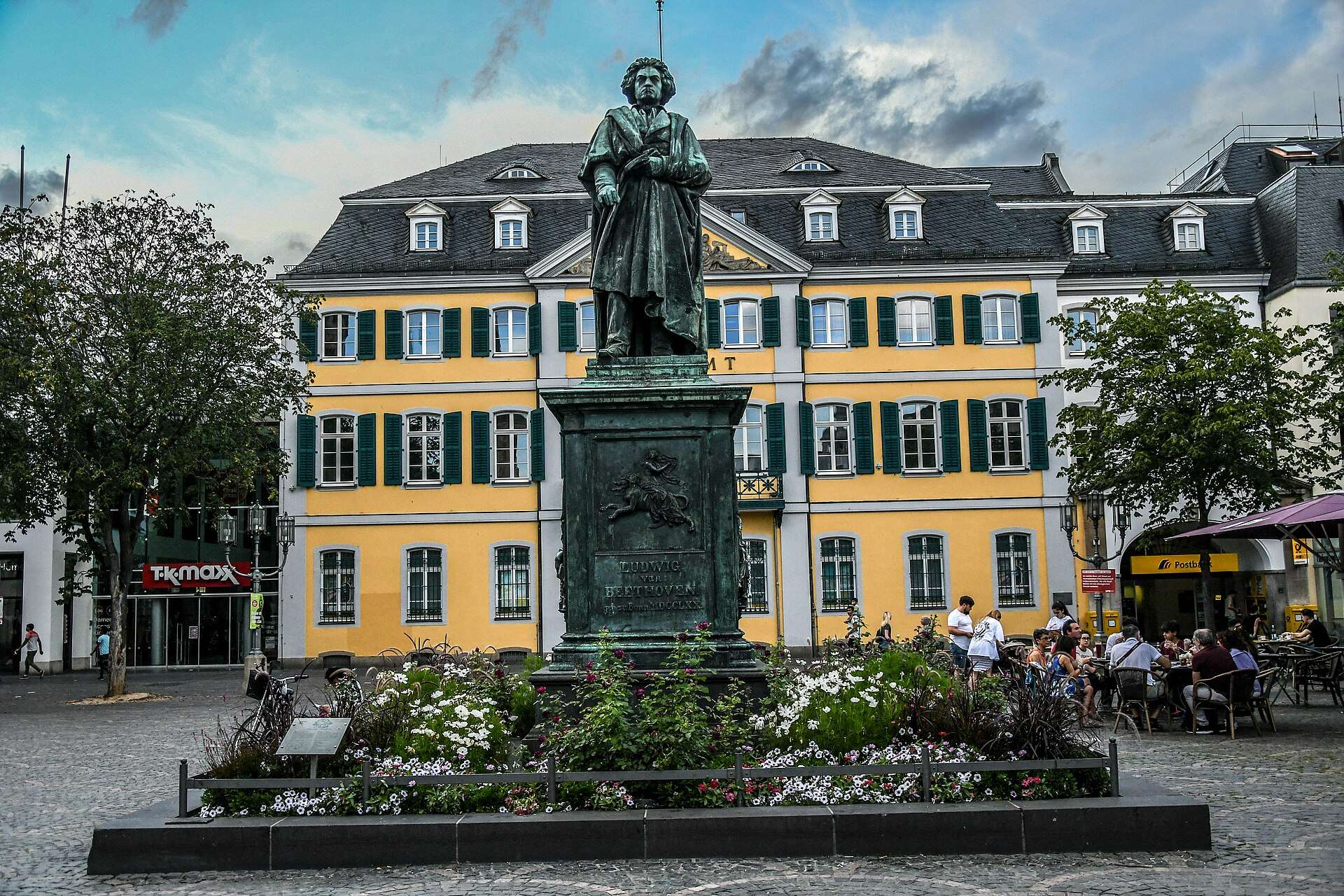
- The Beethoven-Haus is the anchor: the composer’s 1770 birth house holds the world’s leading Beethoven collection — manuscripts and sketchbooks, portraits, his instruments, and the ear trumpets that chart the deafness — with the modern annex handling the interpretive layer (beethoven.de).
- The capital story per the alarm is the town’s second act: Bonn served as West Germany’s capital from 1949 and hosted the government until the 1990s move to Berlin — a provisional arrangement that lasted half a century and left the town its ministries, embassies-turned-offices, and the federal quarter to walk.
- The Haus der Geschichte carries that history free: the Federal Republic from rubble to reunification told through the objects themselves — Adenauer’s Mercedes 300, the first Beetle economics, terrorism-years evidence, the Bonn–Berlin decision — among Germany’s most visited museums at zero admission.
- The Museum Mile stacks the rest along one tram line: the Kunstmuseum’s Rhenish Expressionists (August Macke’s town), the Bundeskunsthalle’s rotating blockbusters, and the science-forward Deutsches Museum Bonn.
- The seasonal and the sweet round it out: April’s Heerstraße cherry-blossom tunnel in the Altstadt (a week or two of pink vault, per the alarm’s photograph), the Rhine promenade toward the Siebengebirge views, and the Haribo fact — HAns RIegel, BOnn, 1920 — with the outlet store as the pilgrimage for the committed.
Getting there
The train frequency makes planning unnecessary — turn up, ride, arrive. The town splits into two easy zones: the compact center (Beethoven-Haus, Münster, market square) on foot, and the Museum Mile a short tram ride south through the former government quarter. April visitors check the blossom forecast — the Heerstraße’s two-week window moves with the spring — and go early on weekend mornings before the lane fills with photographers standing in each other’s shots.
The day
Beethoven first, while the rooms are quiet: the low-ceilinged birth chamber, the sketchbooks’ furious crossings-out, the graded series of ear trumpets telling the deafness year by year, and the late quartets’ manuscripts for anyone who wants to stand very still for a minute. The market square and Münster fill the pre-lunch stroll — Rhenish café culture does the rest. The afternoon takes the tram to the Museum Mile: the Haus der Geschichte’s free half-century walked chronologically (the chancellor’s Mercedes, the Trabant, the sofa where reunification was negotiated on television), with the Kunstmuseum’s Expressionists or a Bundeskunsthalle show as the art course by appetite. The former Bundestag quarter — the Rhine-side parliament buildings now hosting UN offices — extends the walk for the politically curious. The evening train home is a rounding error; the alarm’s you-owe-it-the-day clause refers to the hours between.
When to go
April is the singular window per the alarm — the Heerstraße cherry tunnel plus the Rhine spring — but the town’s substance is all-weather: the Beethoven-Haus and Museum Mile carry any season. September brings the Beethovenfest, the composer’s town programming several weeks of serious concerts. December runs a proper market on the Münsterplatz beneath the Beethoven statue. Summer is for the Rhine promenade and the Siebengebirge ferries for those extending the day upstream.
Frequently Asked Questions
Is the Beethoven-Haus worth it for non-musicians?
Genuinely — the biography tells itself through objects: the trumpets’ escalating sizes, the conversation notebooks visitors wrote questions in when he could no longer hear them, the life mask. Musicians get the manuscripts on top. It’s a house-museum done at world standard in the rooms where the story physically began.
Why was Bonn the capital?
Chosen in 1949 partly for its very modesty — a provisional capital signaling that division was temporary, championed by Adenauer (who lived nearby). The arrangement held until the 1991 Bundestag vote and the late-90s move to Berlin. The Haus der Geschichte tells the whole arc, including the handover, with the federal quarter outside its windows as evidence.
When exactly do the cherry blossoms bloom?
Typically mid-to-late April for the famous Heerstraße canopy, lasting one to two weeks and shifting with each spring — locals and the town’s channels track it closely. Weekday mornings beat the weekend photography scrum. The rest of the Altstadt’s lanes bloom on the same clock with fractions of the crowd.
What’s the Haribo connection?
Hans Riegel founded his candy company in Bonn in 1920 and named it from his own initials plus the town’s: HA-RI-BO. The gummy bear followed in 1922. The factory outlet near town sells by the kilo to pilgrims who treat it accordingly — the alarm’s fact is the free souvenir; the store is the paid one.
Bonn or Aachen from Cologne?
Aachen (documented on this network) for Charlemagne’s chapel and the throne at deeper historical depth; Bonn for Beethoven, modern history, and April’s blossoms at half the ride. Ninth century versus twentieth — the honest Cologne base does both, and the train costs make neither a commitment.